
This page was last updated on: March 16, 2012
Two phases characterize the
operation of WATERPulser.
THE FINAL WORD ON WATERPulser.
WATERPulser's unique 'self cleaning' capability, uniformity of water flow, intrinsic
design flexibility and affordable pricing makes it the leader in its field.
Call or email us for FREE quote on installing
WATERPulser at your home or business.
PULSER
Originates the pulsating action. Has pressure regulator. Allows homeowner to select frequency of emitter flow.
HEADER
Connects the irrigation lines to the pulser.
Rigid PVC pipe underground.
EMITTER
Spreads water like a micro-sprinkler but intermittently. Has large orifice to avoid clogging.
ELASTIC TUBING
Flexible tubing as an accumulator. Can be installed under or over ground.
WATERPulser
has four main components.
Back to
SELF CLEANING: During each cycle the pulse emitters are flushed twice, first by the water filling the line and then by the rapid discharge in the opposite direction. The 'double flushing' action and the large nozzle size generate this capability and sets the WATERPulser apart from other irrigation systems.
Welcome to . . .
WATERPulser.com
HOME IRRIGATION SYSTEM
tm
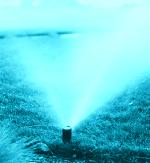
Gently mists your plants and shrubs.
The patented 'water pulsing' action is the same, whether for large agricultural application
or small home landscaping system.
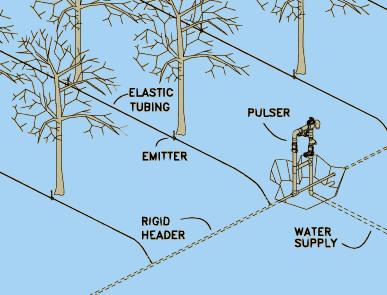
This diagram shows an installation for a large orchard. Home landscaping systems are much simpler in design.
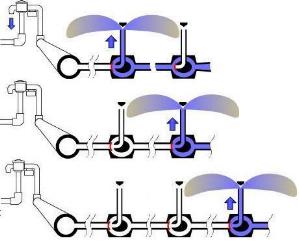
FILLING Stage
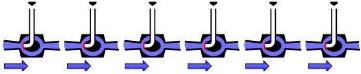
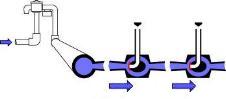
During the filling stage water enters the pulser and proceeds into the header to fill the irrigation lines (plastic tubing).
The emitters remain closed and pressure builds up in the line. After a time interval, pre-selected by the operator, the pulser valve closes the water supply and removes pressure from the header through the discharge port. The discharge phase begins.
header
water supply
pulser
1st emitter
2nd emitter
3rd emitter
4th emitter
5th emitter
6th emitter
7th emitter
8th emitter, etc., etc.
1
2
2nd emitter
discharge port
DISCHARGE Stage
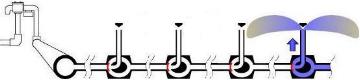
The sudden removal of pressure from the header causes the first emitter to discharge the water contained under pressure in the elastic tubing between the first and the second emitter.
1st emitter
At the end of this discharge, the second emitter
ejects the water contained in the tubing connecting
with the third emitter.
At the end of this discharge, the third emitter
ejects the water contained in the tubing connecting
with the fourth emitter.
At the end of this discharge, the fourth emitter
ejects the water contained in the tubing connecting
with the fifth emitter.
This process continues until all emitters along the line have ejected the water and the line is totally discharged.
At this point, the pulser valve opens the
inlet port and another filling cycle begins.
3rd emitter
4th emitter
tubing
plastic
